
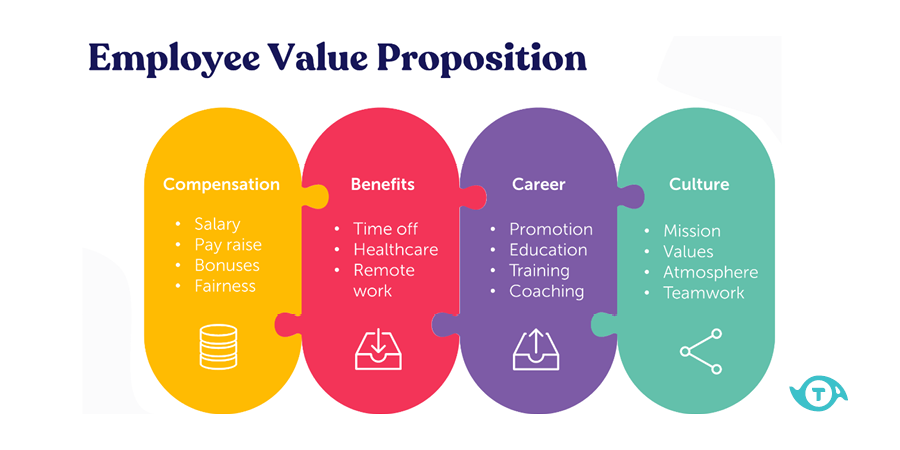
In English-language HR, employee value proposition is the most common term. Employer value proposition is also used, especially when the focus is the company’s promise to candidates. In practice, both are shortened to EVP and often describe the same strategic idea: why the right person should choose your company and why a strong employee should stay.
The distinction matters less than the substance. A useful EVP must be specific, relevant to the people you need, different from competing employers and supported by evidence. If the promise does not match daily work, it is advertising, not an employee value proposition.
What is an employee value proposition?
An employee value proposition is the exchange between an organisation and its people. Employees contribute capability, judgement, time, energy and results. The employer provides compensation, meaningful work, tools, leadership, development, flexibility, relationships and a sense of direction.
An EVP answers four practical questions:
- Who is this workplace for? The answer should identify priority talent groups rather than trying to appeal to everyone.
- What can people expect here? Describe the experience, opportunities and rewards that are genuinely available.
- What does the company expect in return? Strong propositions make responsibilities and trade-offs visible.
- What proves the promise? Policies, employee stories, manager behaviour and measurable outcomes should support every claim.
A weak EVP says: “We are a dynamic team with great benefits and opportunities to grow.”
A stronger EVP says: “Experienced account managers get ownership of their pipeline, clear commercial targets and direct access to strategy and creative teams. In return, we expect independent decisions and disciplined follow-through.”
The second version will not attract everyone. That is the point. A good EVP helps suitable candidates recognise a match and gives unsuitable candidates enough information to opt out early.
Employee value proposition vs employer value proposition
There is no universally enforced distinction between the two phrases. Many HR teams, researchers and platforms use them interchangeably. When a distinction is useful, think of it this way:
| Term | Main perspective | Core question |
|---|---|---|
| Employee value proposition | The experience and value received by employees | What do people genuinely get from working here? |
| Employer value proposition | The promise an organisation makes as an employer | Why should a candidate choose this company? |
The employee perspective should come first because it is the reality behind the promise. The employer-facing message can then translate that reality for the talent market.
For clarity, this guide uses employee value proposition as the primary term and EVP as the abbreviation.
EVP vs employer branding and company culture
EVP, employer branding and company culture are related, but they are not the same thing.
| Concept | What it describes | Typical output |
|---|---|---|
| Company culture | How people actually behave, decide and work together | Leadership habits, operating norms and everyday experience |
| Employee value proposition | Why the employment exchange is valuable and distinctive | EVP pillars, proof points and audience-specific messages |
| Employer branding | How the company communicates and demonstrates that value | Careers site, job ads, content, campaigns and candidate touchpoints |
Your culture is the reality. Your EVP turns the most relevant parts of that reality into a clear promise. Employer branding communicates and proves the promise.
This sequence cannot be reversed. A polished campaign cannot repair an EVP that employees do not recognise. If your careers page promises autonomy but managers approve every minor decision, the campaign may increase applications while also increasing disappointment, early attrition and negative reviews.
Why a clear EVP matters
A useful EVP gives HR, leadership and marketing a shared decision framework. It can improve more than recruitment copy.
It makes the company easier to understand
Candidates compare more than salary. They evaluate the work, manager, flexibility, development, stability, purpose and credibility of the organisation. A clear EVP organises those signals into a proposition they can assess quickly.
It attracts better-matched candidates
Broad promises produce broad interest. Specific promises help the right people self-select. This can improve the relevance of applications even when the total application volume does not increase.
It aligns the employee experience
An EVP creates a reference point for job design, onboarding, leadership communication and people policies. It exposes gaps between what the organisation says and what teams experience.
It gives employer branding substance
Content performs better when it has something concrete to show. Employee stories, manager interviews, project examples and policy details become proof of the EVP instead of isolated campaign material.
The five practical pillars of an EVP
Searches often ask for the “five pillars of EVP”, but there is no single mandatory model. The most useful framework is the one your company can research, prove and maintain. For most organisations, these five areas provide a practical starting point:
| EVP pillar | Questions to answer | Useful proof |
|---|---|---|
| Compensation and security | Is pay fair, understandable and appropriate for the role? | Salary ranges, review process, bonus model and contract stability |
| Work and responsibility | What will people work on, and how much ownership will they have? | Real projects, decision rights, tools and first-90-day expectations |
| Growth and career | How can people improve, move or deepen their expertise? | Career paths, mentoring, learning budget and internal moves |
| Flexibility and wellbeing | How is work organised around performance and life outside work? | Hybrid rules, schedules, leave, workload practices and manager examples |
| Culture, leadership and purpose | How are decisions made, people led and contributions recognised? | Leadership principles, employee feedback, rituals and business impact |
Benefits support these pillars, but a list of benefits is not an EVP. Free coffee, a gym contribution or remote days are individual features. The proposition explains what kind of employment experience those features create and why that experience is valuable to a particular group of people.
How to build an employee value proposition
Start with research, not slogans. The goal is to find a promise that is true today, relevant to priority talent and distinctive enough to influence a decision.
1. Define the talent segments that matter
Different people evaluate employers differently. A senior commercial hire, a production operator and an early-career analyst may work for the same company but need different proof.
Segment by factors that change the employment decision: role family, seniority, location, work pattern, scarce skills or strategic importance. Keep one company-level EVP, then adjust the emphasis and evidence for each segment.
2. Audit the current employment experience
Review what the company already promises and what people actually experience. Useful inputs include:
- employee surveys and engagement comments,
- onboarding feedback,
- exit interviews and early attrition reasons,
- offer acceptance and rejection reasons,
- job advertisements and recruiter scripts,
- careers-site analytics,
- employer-review themes,
- interviews with employees, managers and recent hires.
Look for repeated language. The phrases employees use without prompting are often more valuable than leadership’s preferred adjectives.
3. Compare the talent market
Review the employers competing for the same people, not only companies competing for the same customers. Map their pay transparency, flexibility, career claims, purpose, culture language and supporting evidence.
Do not copy the most common promise. Identify where your experience is meaningfully different or where competitors make claims they cannot prove.
4. Choose three to five EVP pillars
Prioritise themes that are:
- true: employees recognise them now,
- relevant: they matter to the people you need,
- distinctive: competitors cannot say exactly the same thing,
- credible: the company can provide evidence,
- sustainable: leaders and systems can keep delivering them.
An aspiration can be included, but label it as a direction and explain what is changing. Do not present a future ambition as today’s employee experience.
5. Write the proposition and proof points
Use this practical EVP template:
For [priority talent segment], we offer [distinctive work experience and value], backed by [specific proof]. In return, we expect [clear contribution or trade-off].
The proposition does not need to become a public slogan. Its first job is to guide decisions and communication. Shorter campaign lines can be developed after the strategic promise is clear.
6. Test before launch
Test the draft with current employees, recent hires, hiring managers and potential candidates. Ask what they believe, what feels generic, what is missing and which claims need evidence.
If people interpret a pillar in several conflicting ways, rewrite it. If employees reject it, fix the experience or remove the claim.
7. Activate the EVP across the employee journey
An EVP should appear consistently wherever people decide whether to join, stay or recommend the organisation:
- careers pages and role pages,
- job descriptions and recruiter outreach,
- interview questions and candidate materials,
- offer and preboarding communication,
- onboarding and manager expectations,
- internal communication and recognition,
- employee stories and social content.
Consistency does not mean repeating one slogan everywhere. It means using the same strategic pillars with evidence suited to each audience and stage.
Employee value proposition examples
The examples below are working models, not finished slogans. Each combines value with evidence and expectations.
| Talent segment | Example EVP direction | Evidence to show |
|---|---|---|
| B2B sales | Build your own pipeline with clear targets, direct strategic support and a transparent reward model. | Commission rules, lead sources, decision rights and sales enablement |
| Product and technology | Solve meaningful problems with protected focus time, strong technical ownership and visible paths to deeper expertise. | Architecture decisions, meeting rules, learning paths and project stories |
| Manufacturing and operations | Work in a stable, well-organised environment with predictable shifts, practical training and clear safety standards. | Shift planning, onboarding plan, supervisor routines and safety data |
| Healthcare and pharma marketing | Create work that must be commercially effective and responsible in a regulated environment. | Review workflow, specialist access, training and approved campaign examples |
Notice that each example includes a trade-off. Autonomy requires accountability. Stability requires process discipline. Regulated work requires review and evidence. A credible EVP helps candidates understand both sides of the exchange.
A 90-day EVP development plan
| Period | Main objective | Deliverables |
|---|---|---|
| Days 1-30 | Research the current experience | Talent segments, interviews, survey themes, candidate data and competitor map |
| Days 31-60 | Define the EVP | Three to five pillars, proposition, proof library and message variants |
| Days 61-90 | Test and activate | Employee validation, updated priority touchpoints, owners and measurement baseline |
The timeline is long enough to include evidence and employee input, but short enough to avoid turning the EVP into a presentation project with no operational owner.
How to measure EVP performance
Do not judge an EVP by social engagement alone. Measure whether people understand the proposition, whether the right candidates respond and whether the experience delivers on the promise.
| Outcome | Metrics to track |
|---|---|
| Talent attraction | Qualified application rate, careers-page conversion and relevant organic search visibility |
| Recruitment efficiency | Offer acceptance, time to fill, source quality and cost per qualified candidate |
| Promise accuracy | Candidate feedback, new-hire expectation gaps and first-six-month attrition |
| Employee experience | Engagement themes, manager scores, internal mobility and referral participation |
| Retention | Voluntary turnover by talent segment, exit reasons and regretted attrition |
Set a baseline before changing the message. Otherwise, a rise or fall in hiring results may be caused by seasonality, role mix, compensation changes or labour-market conditions rather than the EVP itself.
Common EVP mistakes
Treating benefits as strategy
Benefits are easy to list and easy for competitors to copy. Explain the experience and operating choices behind them.
Writing for everyone
An EVP that tries to attract every candidate becomes generic. Keep a shared core, then use segment-specific messages and evidence.
Letting leadership define the employee reality alone
Executives understand strategy, but employees experience the work. Both perspectives are necessary.
Hiding the trade-offs
Candidates will discover pace, process, hierarchy and workload after joining. Explain important expectations before they accept the offer.
Launching without owners
Every pillar needs someone accountable for delivery. HR may coordinate the EVP, but leadership, managers, communications and operations all shape whether it remains true.
Frequently asked questions
What does EVP mean in HR?
EVP means employee value proposition or employer value proposition. It describes the value and experience an organisation offers in exchange for an employee’s skills, effort and contribution.
Is employee value proposition the same as employer value proposition?
The terms are often used interchangeably. Employee value proposition emphasises what people receive and experience. Employer value proposition emphasises the promise made by the company. Both should describe the same credible employment exchange.
What are the five pillars of EVP?
There is no universal mandatory list. A practical model covers compensation and security, work and responsibility, growth and career, flexibility and wellbeing, and culture, leadership and purpose.
Is EVP the same as employer branding?
No. EVP is the strategic promise and value behind the employment experience. Employer branding is how the company communicates and demonstrates that promise to employees and candidates.
How often should an EVP be updated?
Review it at least annually and after material changes such as rapid growth, restructuring, new leadership, expansion, a change in working model or repeated recruitment and retention problems.
Should every role have a different EVP?
No. The company should have a consistent core proposition. The emphasis, examples and proof should then be adapted for important talent segments.
Turn the EVP into a credible employer brand
An EVP only creates value when the company can deliver it and candidates can see the evidence. Teapot connects research, strategy, careers-site UX, content and recruitment campaigns through our employer branding work.
See how that approach supported local and international talent communication in the Camfil employer branding case study. If your current EVP is a list of benefits or an untested slogan, talk to Teapot about a focused audit of the promise, proof and candidate journey.