
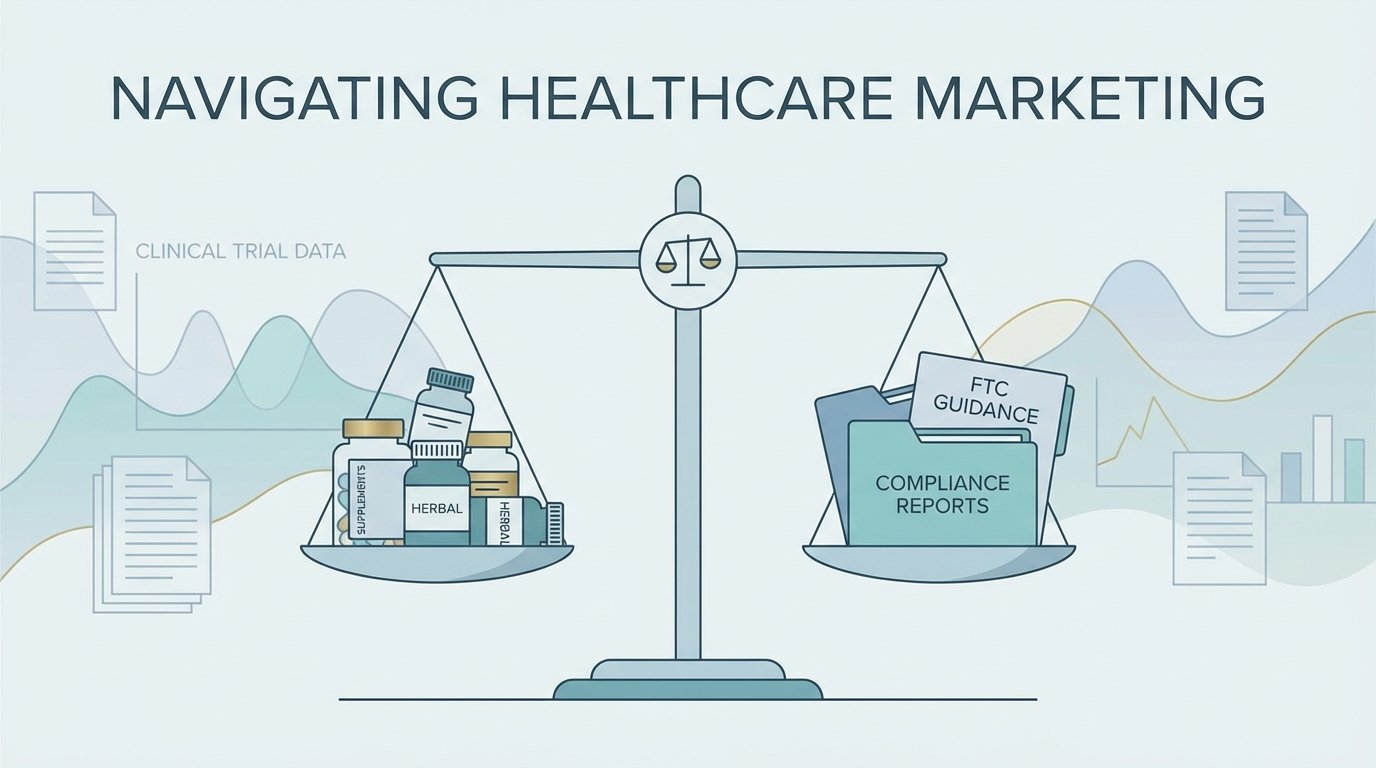
The best supplement advertising rule is operational: decide what the ad is allowed to imply before deciding where it will run. Headlines, images, reviews, creator stories, comparison tables, and CTAs all contribute to the claim.
The research baseline for this article combines US search intent from Ahrefs with official FDA and FTC guidance. The practical goal is not louder healthcare copy. It is a campaign architecture that can carry evidence, risk language, and commercial momentum at the same time.
Search Intent And Positioning
Primary keyword focus: supplement advertising rules. The query has a practical compliance intent. Readers need the line between persuasive supplement advertising and unsupported disease, efficacy, or testimonial claims.
Regulatory Guardrails To Build Around
Start with the FTC net-impression standard and FDA claim categories. FTC Health Products Compliance Guidance covers substantiation and consumer understanding. FDA Structure/Function Claims explains structure/function claims and the need to avoid positioning a supplement as a disease treatment.
This article is marketing strategy content, not legal, regulatory, or medical advice. Final claims should be reviewed by the brand owner, legal counsel, and medical-regulatory reviewers.
A Practical Campaign Framework
| Decision | What to define | Why it matters |
|---|---|---|
| Structure/function | Support normal body function without disease treatment implication | Often useful, but still needs support |
| Disease claim | Treats, prevents, mitigates, or cures disease | High risk for supplement advertising |
| Testimonial | Consumer or expert experience | Needs disclosure, typicality context, and proof |
The practical rule is simple: do not let the media plan decide the claim. The claim decides how much context, review, and destination support the media plan needs.
Channel Decisions
| Channel | Best role | Main risk |
|---|---|---|
| Paid search | Answer intent with compliant landing page | Ad copy compresses qualification |
| Short video | Explain category and routine | Visuals imply medical transformation |
| Retail PDP | Convert with proof and reviews | Claims drift through bullets and UGC |
| Replenishment and education | Aggressive urgency around health outcomes |
Every channel should have a job it can realistically perform. If a format cannot show the qualification, limitation, or risk context that makes the claim accurate, the format should route to a deeper page instead of carrying the full promise alone.
Teapot POV
Write the rules into the brief, not the legal comments. Every concept should carry a claim category, evidence source, forbidden phrases, mandatory qualifiers, and review route before media formats are built.
For pharma and healthcare teams, this is where strategy becomes implementation: one evidence file, one claim map, one route from content to conversion, and one measurement model that separates attention from qualified action.
FAQ
Can a supplement ad mention a disease?
Usually this is high risk. Disease treatment or prevention language can move the message outside ordinary supplement advertising.
Do disclaimers fix weak claims?
No. Disclaimers help only when the main net impression is already truthful and supported.
Should legal review every ad variant?
The process should review the claim system and reusable modules, then control variants through approved guardrails.
Practical Next Step
Before creative production starts, write a one-page claim map: audience, allowed claim, proof source, channel, review owner, and destination page. If the claim cannot fit that memo cleanly, the campaign is not ready for media spend. For a deeper service view, start with Teapot Pharma or talk to us.